
To get cited by ChatGPT, you need three things: pages its crawlers can fetch, content retrievable for the sub-queries its search generates, and an extractable fragment worth quoting. OAI-SearchBot and ChatGPT-User are the crawlers. In Search Engine Land's November 2025 dataset, 72.4% of cited blog posts carried an identifiable answer capsule.
One boundary line first: this guide is for brands that want ChatGPT to cite them. Citing ChatGPT in a paper — APA, MLA, Chicago — is the other question this results page answers; one FAQ below covers the formats.
- 72.4% of cited blog posts carried an identifiable answer capsule (Search Engine Land, November 2025).
- 56% of paid-tier citations went to brand-owned sites; the free default sent 8%.
- Guide-format URLs earn 42% more citations in Otterly's million-URL study.
- On-site work moves the paid tier; off-site mentions move the free tier.
- Re-test monthly and after every model release.
The two questions fight over one SERP, measurably. My Google SERP data snapshot for "how to get cited by chatgpt" (Google US, July 9, 2026) captured 97 organic listings — 90 unique URLs. I classified every one. 49 teach students to cite ChatGPT in a reference list. 39 teach marketers to earn ChatGPT citations . 2 do neither.
The academic side holds the top organic slots — APA Style the first organic result (#3 absolute, behind the SERP features); the first marketer page, a Reddit thread, sits at #7. The AI Overview above them all picked the other side. It opens "To get cited by ChatGPT, optimize your web content…" and draws on 16 sources — not one academic.
Google's generative layer reads this as a marketing question. Its organic index still files it under bibliography help. This page answers the question the AI Overview thinks you asked — with data, a test, and numbered steps.
How ChatGPT citations work
ChatGPT cites sources only when it searches the live web. It splits your prompt into sub-queries via query fan-out and retrieves pages through its search stack — the Bing index plus OpenAI's own OAI-SearchBot crawl. The URLs it used get linked. Answers written from training data alone carry no citations.
That mechanic splits "getting cited" into two games — training data vs browsing — and most guides conflate them. Training-data mentions decide what the model says when it doesn't search. They accrete from years of consistent brand mentions across the open web and change only when OpenAI ships a new model.
Search citations refresh with every crawl. (OpenAI first previewed ChatGPT search as SearchGPT.) That's the game you can play this quarter, and the one this page covers.
Which model tier answers decides who gets in. Writesonic extracted full conversation payloads for 50 prompts across ChatGPT's model tiers: 119 conversations, 1,161 classified citations. GPT-5.4 Thinking, the paid tier, sent 56% of its citations to brand-owned sites. GPT-5.3 Instant, then the free default, sent 8%.
Citation overlap between the tiers on the same prompt averaged 7%. On 22 of 50 prompts it was exactly zero. GPT-5.5 replaced both defaults in early May 2026, and Writesonic's re-run showed the new free tier citing brand sites 6% of the time. Reddit became its most-cited domain at 38 citations, against Forbes's 6.
Read those numbers as a channel map. Free-tier users — most of ChatGPT's audience — get answers where roughly 94 of every 100 cited URLs are third-party: Reddit threads, review sites, media roundups. Paid Thinking-tier users see brand sites nearly half the time — 47% first-party in the GPT-5.5 study.
The split held across all 16 tested prompt categories, from SaaS (82% first-party on GPT-5.4) down to shopping, the least brand-forward of them. ChatGPT shopping answers draw on that same third-party pool. Your own site wins on the paid tier. Everyone else's coverage of you wins on the free tier. A strategy that only polishes your own pages plays half the board.
Three OpenAI user agents touch your site. They are not interchangeable.
| User agent | What it feeds | If you block it |
|---|---|---|
| GPTBot | Training data for future models | You opt out of model training, not of ChatGPT search. |
| OAI-SearchBot | ChatGPT's search index | Your pages can't surface as cited sources in ChatGPT search. |
| ChatGPT-User | Live page fetches during a user's chat | ChatGPT can't read your page when a user asks about it. |
Check robots.txt and CDN bot defaults for all three separately. Blocking GPTBot while expecting ChatGPT citations is a coherent position. Blocking OAI-SearchBot while expecting them is not.
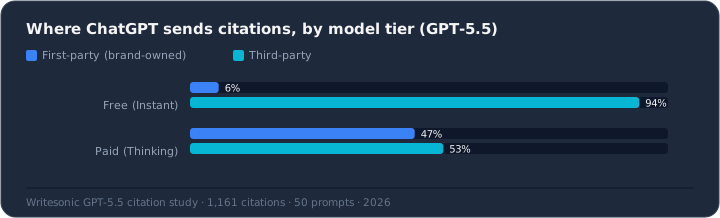
Source: Writesonic GPT-5.5 citation study, 1,161 classified citations across 50 prompts, 2026. Free-tier users see ~94% third-party sources.
The test: does ChatGPT cite you already?
Run a fixed prompt set through ChatGPT with search enabled, on both the free and paid tiers, and log whether your domain gets cited. Six prompt shapes, one spreadsheet — prompt, model, date, brand named, URL cited, position. Cost: $0. Time: about 30 minutes. Repeat monthly and after every model release.
The baseline usually stings. A founder on r/SaaS ran the one-prompt version in May 2026: "Asked ChatGPT: 'what's the best tool in my category?' My product wasn't mentioned. Three competitors were."
His Google rankings were solid. His conclusion: "Being indexed by Google doesn't mean ChatGPT knows you exist." The protocol below is that test made reproducible.
1. Write six prompts, once.
- A category prompt ("best {category} for {use case}").
- The exact question your money page answers.
- A comparison ("{your brand} vs {competitor} — which should I pick?").
- A recommendation with constraints ("recommend a {category} for a 20-person team on a budget").
- A local prompt if local business visibility matters ("{service} near {city} that takes online booking").
- And a source probe to append after any answer: "which sources did you use?"
2. Kill the personalization. Run every prompt in a temporary chat, or with conversation memory turned off. Memory carries your previous chats into the answer. A ChatGPT that watched you research your own brand for a month is not the ChatGPT your customers use. Fresh session per prompt.
3. Run each prompt on both tiers, search on. The tiers cite different webs — 7% average overlap. Verify which model actually answered. In Writesonic's Instant run, 8 of 50 prompts silently escalated to the Thinking tier, and 7 of the 8 escalated again on a re-run with auto-switching disabled.
4. Log five fields. Prompt, model, date, brand named (yes/no), your URL cited (yes/no) plus its position among the citations.
5. Score it. Cited share of prompt queries is your baseline; tracked against competitors it becomes AI share of voice . Four readings.
- Named and cited: defend, keep the page fresh.
- Named but never cited: training data knows you, search can't retrieve or extract you — fix the anatomy (next section).
- Competitors named, you absent: an off-site gap — step 5 of the playbook.
- Nobody named: your prompts are too broad to be commercial — tighten and re-run.
6. Re-test monthly and after every model release. The May 2026 default swap moved Reddit from 6 citations to 38 overnight. A baseline measured on the old model says nothing about the new one.
This manual protocol is the $0 version of what AI visibility platforms automate. If you'd rather not build the spreadsheet, our free checker runs the same sampling.
What makes a page citable
Cited fragments share four traits: a 40–60-word direct answer placed right under a question-shaped heading, at least one verifiable number, a visible date, and no link clutter inside the block. 72.4% of LLM-cited posts carried such a capsule in Search Engine Land's dataset; guide-format URLs earn 42% more citations in Otterly's million-URL study.
The capsule finding is the strongest published evidence on this SERP. Search Engine Land analyzed the content traits of LLM-cited posts on November 19, 2025. It ranks #8 on this query — the only marketer page in the classic ranks with a dataset behind it.
The finding: 72.4% of cited blog posts included an identifiable answer capsule . The AI Overview citing that study surfaces a second trait from the same dataset: minimal link density inside the capsule. Both are applied on this page.
Otterly measured the other direction : what already-cited URLs look like. The dataset: 1,028,959 unique URLs cited by six AI platforms (ChatGPT among them) in a 24-hour window — 1.93 million citation instances. URLs with /guide/ in the path averaged 2.7 citations against a 1.9 baseline, 42% above. Pricing pages performed worst at 1.5.
URLs carrying query strings averaged 1.6 citations against 2.1 for clean ones. And URL length showed a correlation of r = −0.025 with citation count — statistically nothing. Stop polishing slugs; start restructuring guides. The distribution is the sobering part: the median cited URL earned exactly one citation, while the most-cited earned 965. Citations concentrate.
This article's own SERP doubles as a live specimen. I classified the 16 sources the AI Overview cites for "how to get cited by chatgpt". The mix: 8 blog guides, 3 YouTube videos, 2 Reddit threads, 2 LinkedIn posts, 1 Medium post. Academic pages: zero, even though they hold the top organic slots (#3 APA Style, #9 Purdue).
Every source the generative layer picked answers the marketer question. Most carry 2025–2026 dates. The two most prominent open with a number (the SEL study) or a numbered list (the Reddit thread). Extraction favors pages built like answers, not pages that merely rank.
| Trait of cited fragments | Implementation | Evidence |
|---|---|---|
| Answer capsule up top | 40–60 words directly under the H1 and each major H2, no links inside the block | 72.4% of cited posts carried one (SEL, Nov 2025). |
| A number in the capsule | One verifiable statistic with source and date | Adding statistics raised generative visibility up to 40% ( arXiv:2311.09735 , KDD 2024). |
| Self-contained paragraphs | Each paragraph answers on its own — no "as mentioned above" | r/ChatGPT testing thread, Feb 2026; matches SEL's extractability traits. |
| Freshness signals | Dated claims, visible update dates | Most AI Overview sources on this SERP are dated 2025–2026. |
The Princeton paper behind that 40% figure — the study that coined " generative engine optimization " — also benchmarked what fails. Keyword stuffing produced no visibility gain.
A tester on r/ChatGPT reached the same anatomy from the outside in February 2026. Direct answers at the top are "easier to extract," the tester wrote. "Structured sections and self-contained paragraphs matter a lot."
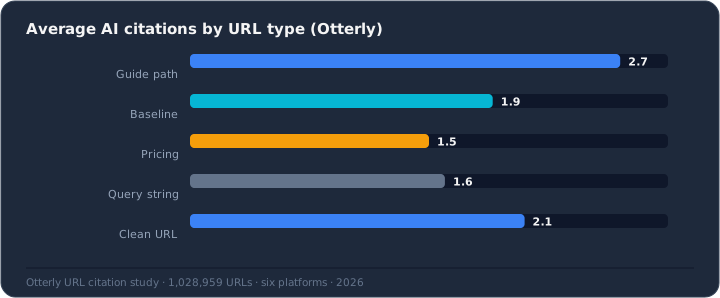
Source: Otterly URL citation study, 1,028,959 unique URLs across six AI platforms in a 24-hour window.
Getting cited, step by step
Six steps, in dependency order:
- Allow OAI-SearchBot and ChatGPT-User in robots.txt and CDN bot rules.
- Get the pages you want cited into the Bing index.
- Restructure money pages answer-first, as guides.
- Put a sourced statistic in every capsule.
- Earn third-party mentions on the domains default models cite.
- Re-test monthly and after every model release.
On-site work moves the paid tier; off-site mentions move the free tier.
Step 1 — Unblock the crawlers. Allow OAI-SearchBot and ChatGPT-User in robots.txt, and audit your CDN's bot rules. Several bot-management products block AI crawlers wholesale by default.
Step 2 — Get into the index, and drop the ranking myth. ChatGPT search retrieves through the Bing index plus OpenAI's own crawl. Verify your site in Bing Webmaster Tools and submit the pages you want cited. Then calibrate expectations: index membership is the gate, public rankings are not the mechanism.
In Writesonic's cross-check, only 2–7% of ChatGPT-cited domains appeared in Bing's top 10 for the same query. 84% of GPT-5.5 Thinking's cited domains appeared in neither Google's nor Bing's top 10. ChatGPT operates as its own answer engine, not a wrapper over anyone's rankings.
Step 3 — Rebuild the pages you want cited as guides. Question-shaped H2s, a capsule under each, self-contained sections, a visible date. The format pays measurably: guide-path URLs averaged 42% more citations than baseline in Otterly's data, and pricing pages came last. Reference content gets cited; transactional content gets skipped.
Step 4 — Give every capsule a number worth quoting. A sourced statistic makes the fragment a snippet candidate and citation bait at once. No proprietary data?
Assemble some: a price comparison you computed, a spec table, a tested step-by-step with real timings. A page competitors can't cheaply replicate is exactly the page a synthesis engine has to cite.
Step 5 — Earn mentions where the default models look. This is the heaviest lever, documented twice. Writesonic's GPT-5.3 run named the kingmakers: Forbes (15 citations), TechRadar (10), Tom's Guide (10), Reddit (7). On GPT-5.5 Instant, Reddit alone took 38. A June 2026 r/MarketingandAI case shows the lever firing.
An agency ran the full on-site checklist for a B2B client — "Schema, an llms.txt file, rewrote half the site into FAQ blocks. Nothing. Genuinely zero change over like two months." Then the client started appearing by name in ChatGPT recommendations. The cause: "some 'best [x] companies' roundup had added him a couple weeks before. That was it. That was the whole thing."
On a tier where 94% of citations are third-party, one roundup inclusion beating two months of on-page work is the expected result. Pitch the roundups, review platforms, and subreddit threads already cited for your category prompts — your test log is the target list.
Step 6 — Re-test on a calendar. Monthly, plus after every model release. The payoff tends to show up in sales calls before analytics. An agency operator on r/GEO__AI__SEO tracked B2B clients into February 2026. Traffic stayed flat and rankings held.
The intake calls filled with "ChatGPT recommended you" and "Claude listed you as one of the top tools." Brand mentions inside AI answers convert without a click. If the six steps surface more problems than your team can sequence, that sorting is what the GEO audit does for a living.
This page covers one surface — the broader ChatGPT playbook covers recommendations and rankings end to end. The owner's plain-English version — "get recommended," not "get cited" — lives in the small-business guide .


No comments yet